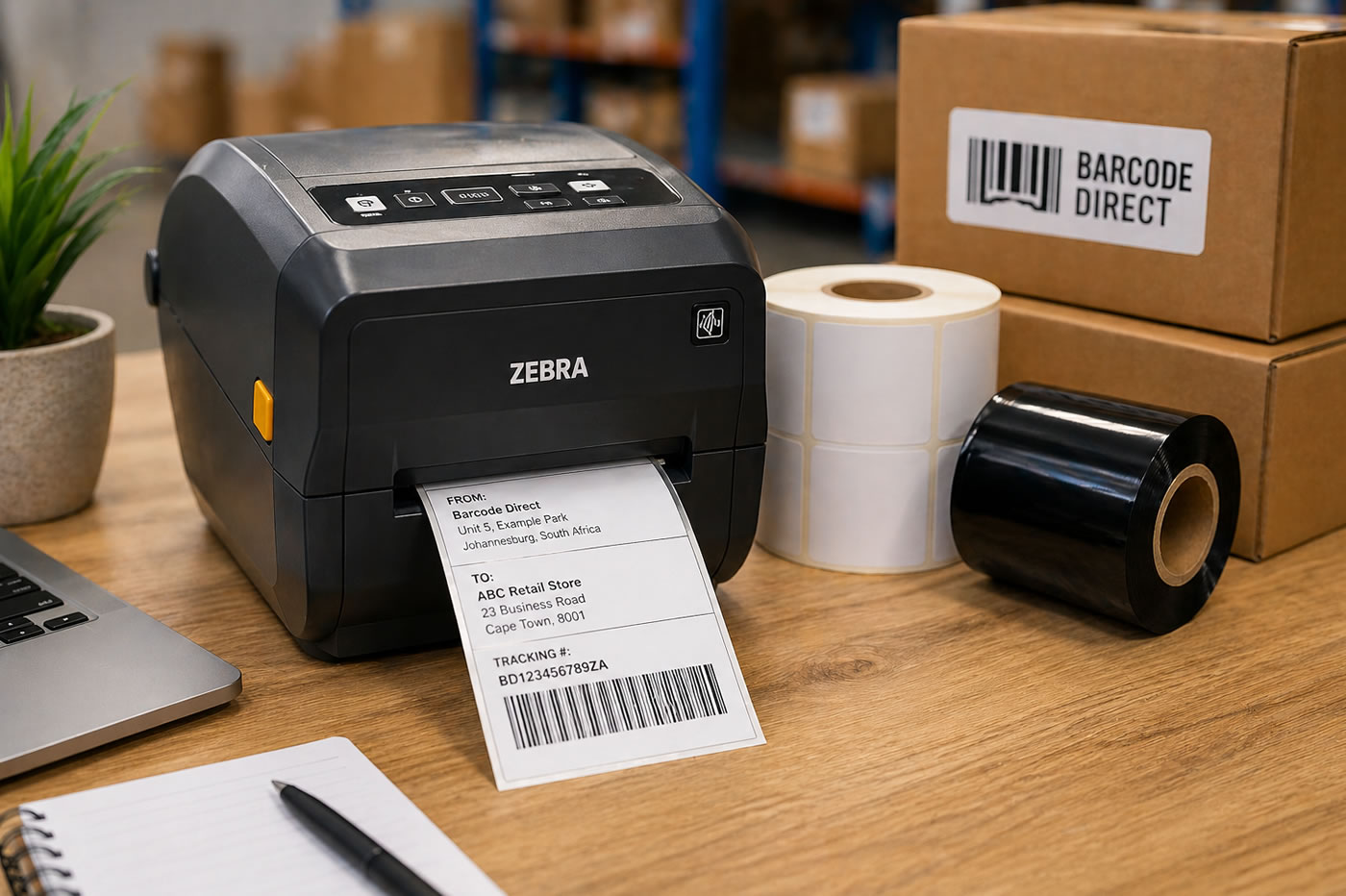




For many businesses, printing costs slowly creep up over time without anyone noticing.
A few extra labels per roll. Ribbon changes happening more often than expected. Labels being reprinted because barcodes do not scan properly. Staff increasing print darkness to solve quality problems. Before long, what seems like a small operational expense becomes a meaningful monthly cost.
The good news is that reducing printing costs does not mean accepting poor print quality.
With the right printers, labels, ribbons, settings, and processes, businesses can often reduce their printing spend while maintaining — and in some cases improving — print performance.
At Barcode Direct, we help businesses optimise barcode and label printing across South Africa by improving efficiency rather than simply using cheaper consumables.
Stop Over-Specifying Your Labels
One of the most common mistakes businesses make is using labels designed for harsher conditions than the application actually requires.
A label designed to survive chemicals, sunlight, and heavy abrasion costs more than a label intended for shipping cartons.
Ask yourself:
How long does the label actually need to last?
If labels only need to survive:
- dispatch
- courier transport
- temporary stock movement
then simpler materials and print methods may significantly reduce costs.
For example:
Short-term applications often perform extremely well with:
- Direct Thermal Label
Long-term applications may justify:
- Thermal Transfer Label
Choosing correctly can reduce total consumable spend without reducing quality.
Choose the Correct Ribbon — Not the Most Expensive Ribbon
Many businesses assume that higher-spec ribbons automatically mean better printing.
That is rarely true.
Using a premium resin ribbon on a simple paper shipping label often increases costs unnecessarily.
The correct approach is to match ribbon type to the label material.
Typical examples:
- Paper labels → Wax ribbon
- Semi-gloss labels → Wax/Resin ribbon
- Synthetic labels → Resin ribbon
- Textile labels → Textile resin ribbon
Inkanto ribbons are widely used because they offer reliable print performance across multiple substrates while helping reduce unnecessary ribbon consumption.
The goal is not cheaper ribbons.
The goal is appropriate ribbons.
Lower Print Darkness Before Changing Consumables
This is one of the easiest ways to reduce printing costs.
When print quality starts dropping, many operators immediately:
- increase darkness
- slow print speed
- replace ribbons
- replace printheads
But excessive darkness can:
- waste ribbon
- wear printheads faster
- increase energy usage
- create smudging
Modern printers often produce excellent barcode quality using lower darkness settings than expected.
A small optimisation can significantly reduce ongoing consumable usage.
Printhead Life Matters More Than Most Businesses Realise
The printhead is one of the most expensive consumable components in thermal printing.
Many premature failures happen because of:
- incorrect ribbon selection
- excessive heat settings
- dirty media
- poor cleaning routines
- low-quality consumables
Simple maintenance dramatically improves printhead life.
Recommended habits:
- clean printheads regularly
- remove adhesive build-up
- use quality media
- avoid unnecessary darkness increases
Protecting the printhead reduces both downtime and replacement costs.
Reduce Label Waste Through Correct Sizing
Printing oversized labels creates hidden costs.
A label that is only a few millimetres too large can create thousands of rand of additional media usage over time.
Businesses should evaluate:
- actual information requirements
- barcode size requirements
- compliance requirements
- available printer widths
Smaller labels often mean:
- more labels per roll
- fewer roll changes
- lower freight costs
- improved efficiency
Optimising label dimensions can create surprisingly large savings.
Use the Right Printer for the Volume
Printer selection affects total cost more than many businesses expect.
Running a small desktop printer continuously for industrial volumes often creates:
- more downtime
- more maintenance
- slower production
- higher replacement frequency
A better approach is selecting printers based on expected output.
Examples:
Desktop environments:
- Honeywell PC41E-D
- Zebra ZD231
Industrial environments:
- TSC T4000
- Honeywell PM45
The cheapest printer is not always the lowest-cost printer over time.
Standardise Labels Across the Business
Businesses often accumulate unnecessary label variations over time.
Different:
- label sizes
- ribbon grades
- printers
- materials
all increase inventory complexity and purchasing costs.
Standardising where possible creates:
- higher purchasing volumes
- simplified stockholding
- easier training
- lower waste
Even reducing from ten label types to six can create meaningful savings.
Measure Cost Per Label — Not Cost Per Roll
This is where many purchasing decisions go wrong.
A cheaper roll does not always mean cheaper printing.
Instead calculate:
- media cost
- ribbon cost
- labels per roll
- maintenance
- downtime
- labour
The true measure should be:
cost per usable printed label
That number often changes purchasing decisions completely.
Quality Still Matters
Reducing printing costs should never result in:
- unreadable barcodes
- customer complaints
- relabelling
- failed scans
- damaged branding
Poor print quality creates hidden costs that quickly exceed any consumable savings.
The objective is simple:
Print only as much quality as your application actually requires.
No more.
No less.
Barcode Direct Helps Businesses Optimise Printing Costs
At Barcode Direct, we help businesses reduce printing costs while maintaining excellent barcode quality.
We supply:
- barcode printers
- labels
- Inkanto ribbons
- mobile printing solutions
- printer accessories
- thermal printing advice
Whether you print hundreds or hundreds of thousands of labels per month, our team can help optimise your printing environment.
Need Help Reducing Your Printing Costs?
Contact Barcode Direct for expert advice on reducing printing costs, improving print quality, and selecting the right barcode printing solution for your business.